Imagine standing on a bustling street corner in Paris. The air smells of rain and roasting coffee, and around you, a melody of sounds flows—fast, fluid, and undeniably elegant. You catch a word here and there—restaurant, taxi, pardon—and for a fleeting second, you feel a connection. But then the stream of sound rushes on, leaving you wishing you could do more than just listen. Perhaps you have seen children chatting effortlessly in French immersion classes and wondered why it seems so natural for them, or maybe you have watched Lupin or Call My Agent! and felt the urge to understand the dialogue without your eyes glued to the subtitles. That spark of curiosity, that desire to connect, is exactly where every linguist, every traveler, and every polyglot began.
You are standing at the threshold of a new world. Starting the French language for beginners can feel like staring up at a mountain. The grammar books look thick, the pronunciation sounds elusive, and the fear of making mistakes can be paralyzing. But here is the truth that often gets lost in academic textbooks: French is not a fortress to be besieged; it is a conversation to be entered. It is a language deeply entwined with English, sharing history, vocabulary, and logic.
This report serves as your comprehensive guide to navigating the early stages of this journey. We will dismantle the myths, map out a realistic path, and provide you with the practical, “human” strategies you need to build a sustainable practice. We will not promise you fluency in 30 days, because that does not exist. Instead, we will offer you a roadmap rooted in linguistic reality and pedagogical experience, designed to take you from “zero” to a place of comfort and confidence.
Is French an easy language to learn for beginners?
One of the most common questions prospective learners ask is: is french an easy language to learn, or is it a linguistic nightmare wrapped in silent letters? The answer, as with most things in language acquisition, is nuanced. It depends entirely on your native language, your previous experience, and your willingness to embrace ambiguity. For an English speaker, however, the news is generally good—with a few notable caveats.
The Anglophone Advantage: A Shared History
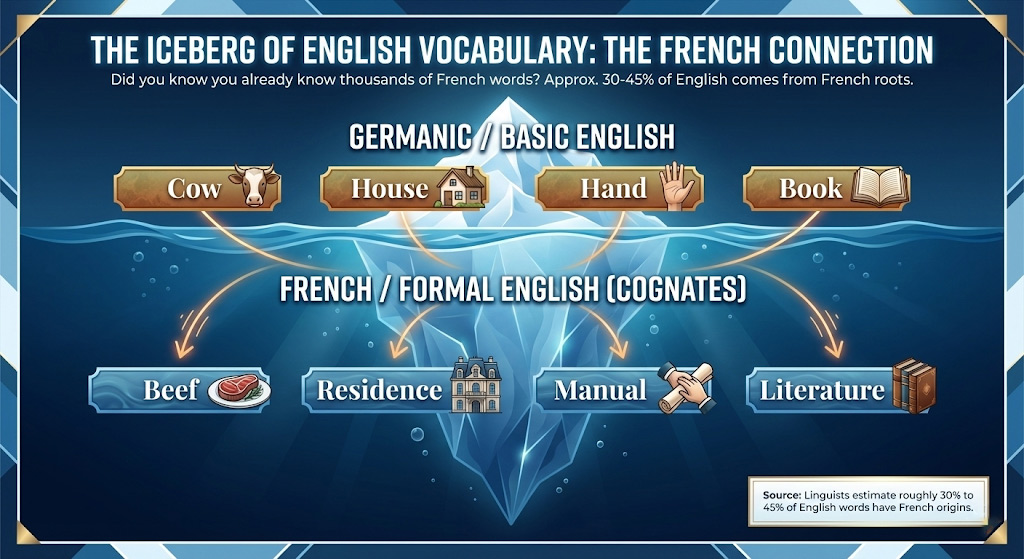
If you speak English, you already know thousands of French words. You just pronounce them with an English accent.
This is not an exaggeration. Following the Norman Conquest of 1066, French became the language of the English court, administration, and law for centuries. As a result, English absorbed a massive amount of French vocabulary. Linguists estimate that roughly 30% to 45% of English words have French origins. This creates a massive “discount” for learning of french language for beginners. You do not need to learn the word for justice, court, prison, jury, or parliament from scratch—they are nearly identical in both languages.
Consider the culinary world. In English, we raise cows, pigs, and sheep (Germanic words), but we eat beef (bœuf), pork (porc), and mutton (mouton)—all French words. This lexical overlap extends into abstract concepts, government, art, and science.
Table 1: The “Free” Vocabulary of French (True Cognates)
| Category | English Word | French Word | Note |
| Academic | Information | Information | Identical spelling, different pronunciation |
| Social | Invitations | Invitations | Suffixes like -tion are highly reliable cognates |
| Food | Restaurant | Restaurant | Core travel vocabulary is often shared |
| Emotions | Terrible | Terrible | Adjectives often share roots |
| Arts | Literature | Littérature | Minor spelling changes (accents, double letters) |
This shared vocabulary means that when you ask how hard is french language to learn, the answer regarding vocabulary is “surprisingly accessible.” You can look at a French text and often guess the general meaning of 30-40% of the words without ever opening a dictionary.
The Phonological Hurdle: Why It Sounds So Different
If the vocabulary is so similar, why does French sound so foreign? This is where the challenge lies. French phonology (the sound system) is significantly different from English.
- The “Melody” (Intonation): English is a stress-timed language. We emphasize specific syllables (e.g., “pho-TO-gra-phy”). French is a syllable-timed language. Syllables are given roughly equal time, and stress typically falls on the last syllable of a rhythmic group. This gives French its machine-gun or flowing quality, which can make it hard for beginners to identify where one word ends and the next begins.
- Nasal Vowels: French utilizes four distinctive nasal vowels (as in vin, an, bon, un). These sounds, produced by pushing air through the nose and mouth simultaneously, do not exist in standard English dialects. Mastering these requires physical practice and can feel unnatural at first.
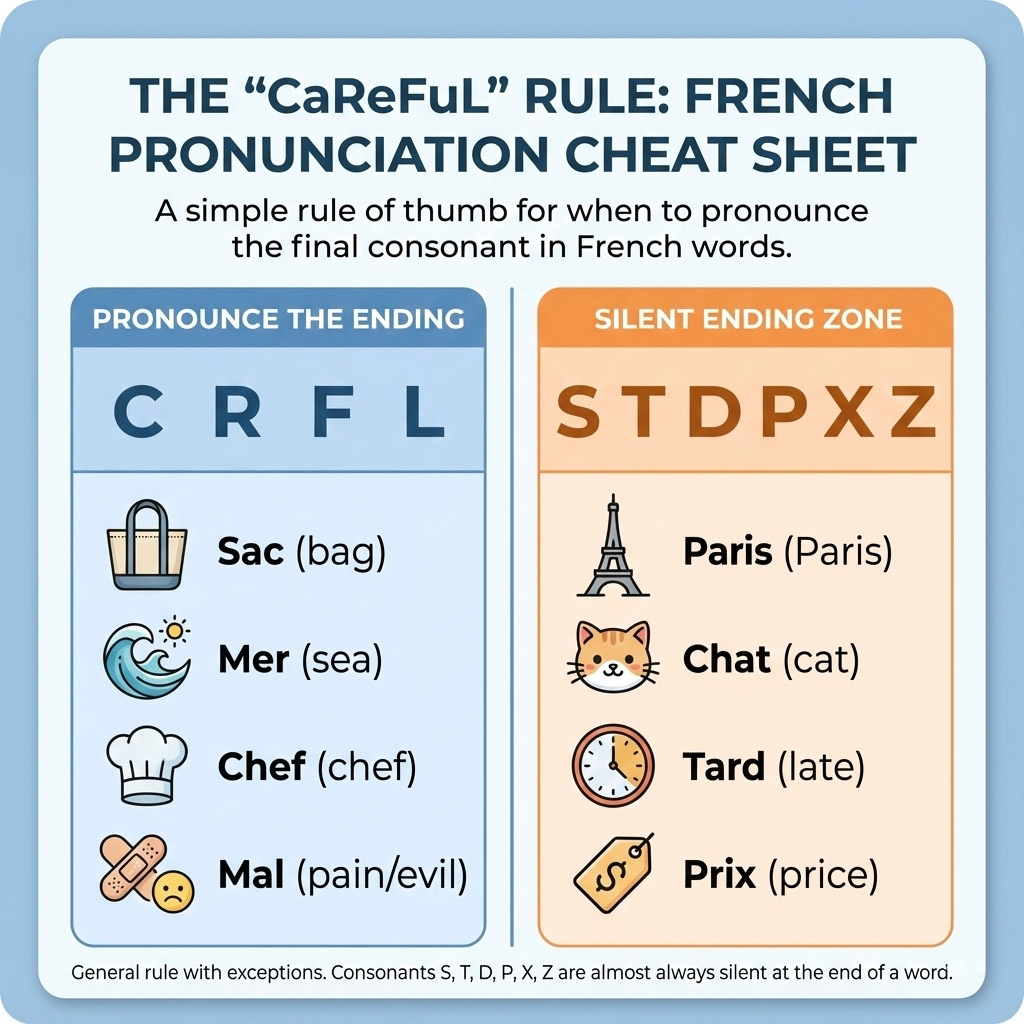
- Silent Letters: French orthography is notorious for silent endings. In English, we usually pronounce the final letters of words (with exceptions). In French, the final consonants D, P, S, T, X, Z are almost always silent unless followed by a vowel. For example, the word chats (cats) sounds identical to chat (cat).
The Grammatical Shift: Gender and Verbs
Beyond sound, the structure of the language introduces concepts that English speakers often find baffling.
- Gendered Nouns: In English, a table is “it.” In French, a table is “she” (la table), and a desk is “he” (le bureau). Every noun has a grammatical gender, and this gender determines the form of the adjectives and articles around it. There is often no logical reason for why an object is masculine or feminine, forcing the learner to memorize the gender alongside the vocabulary word.
- Verb Conjugation: English verbs are relatively static (I speak, you speak, we speak). French verbs change form for every person (je parle, tu parles, nous parlons). This requires a significant amount of memorization, particularly for irregular verbs.
Verdict: Is it Easy?
It is “accessible.” Compared to Mandarin, Arabic, or Japanese, French is incredibly approachable for an English speaker. The Foreign Service Institute (FSI) classifies French as a Category I language, meaning it is among the easiest for English speakers to learn, requiring roughly 600–750 class hours to reach proficiency. However, compared to Spanish, French presents a steeper initial challenge due to pronunciation and spelling rules.
What you actually need to begin learning French (not 20 apps at once)
In the digital age, the biggest trap for learning of french language for beginners is “resource paralysis.” You might download Duolingo, buy a textbook, subscribe to three YouTube channels, and follow five Instagram polyglots. Two weeks later, overwhelmed by notifications, you quit.
To succeed, you do not need more tools; you need a balanced ecosystem. Language learning rests on four pillars. Neglecting one will leave your skills lopsided.
1. Listening (Input)
This is often the most neglected skill in traditional classrooms, yet it is arguably the most important for beginners. You must train your ear to parse the sounds of French before you can expect to speak it.
- The Goal: To get used to the rhythm and “music” of the language.
- The Tool: Passive listening. Podcasts (like Coffee Break French or InnerFrench), French radio, or even French playlists on Spotify.
- The Strategy: Listen while you commute, cook, or clean. Do not worry about understanding every word. Your brain needs to categorize the phonemes (sounds) of French.
2. Speaking (Output)
Many learners wait until they are “ready” to speak. This is a mistake. You should begin making sounds from Day 1, even if you are just talking to your cat.
- The Goal: To build muscle memory in your mouth. French requires you to use your lips and tongue differently than English.
- The Tool: Voice recording apps, reading aloud, or shadowing (repeating immediately after a native speaker).
- The Strategy: Read your vocabulary lists out loud. If you only read silently, you are learning to read, not to speak.
3. Reading (Vocabulary Acquisition)
Reading is the fastest way to acquire vocabulary because you can see the words and cognates clearly.
- The Goal: To recognize patterns and build a database of words.
- The Tool: Graded readers (books written for learners), simple news sites, or bilingual books.
- The Strategy: Read texts that are slightly above your level. Do not look up every word; try to guess the meaning from the context.
4. Writing (Consolidation)
Writing forces you to slow down and process the grammar. You cannot “mumble” a written sentence; you have to know how to spell it and agree with the adjectives.
- The Goal: To solidify grammar and spelling.
- The Tool: A simple notebook or a journaling app.
- The Strategy: Write 3-5 sentences a day about what you did. “Today I ate an apple. It was good.” (Aujourd’hui, j’ai mangé une pomme. C’était bon.).
The “Less is More” Toolkit
Instead of 20 apps, start with this “Minimalist Stack”:
- One Daily Habit App: (e.g., Duolingo or Babbel) for 15 minutes to keep the streak alive.
- One Reference Dictionary: (e.g., WordReference or Linguee) for checking meanings.
- One Listening Source: A podcast or YouTube channel for immersion.
- A Notebook: For writing down words by hand (which aids memory).
Beginner French lessons: what a good first month looks like
When looking for french beginner lessons, it is easy to get lost in complex grammar explanations about the subjunctive mood. Forget that. In your first month, your goal is survival and comfort. You want to build a “usability island”—a small set of skills that lets you handle basic interactions.
Here is a realistic roadmap for your first four weeks.
Week 1: Breaking the Ice
The first week is about overcoming the “strangeness” of the sounds and learning the absolute basics of politeness. French culture places a massive emphasis on politeness.
- Focus: Greetings and Politeness.
- Key Phrases: Bonjour (Hello/Good morning), Bonsoir (Good evening), Au revoir (Goodbye), S’il vous plaît (Please), Merci (Thank you).
- The “Safety Net” Phrases: Learn these immediately: Je ne comprends pas (I don’t understand) and Parlez-vous anglais? (Do you speak English?).
- Grammar: Do not touch a grammar book yet. Just memorize these phrases as whole “chunks” of sound.
Week 2: Defining Identity
Now that you can say hello, you need to say who you are.
- Focus: Introducing yourself.
- Key Verbs: Être (to be) and Avoir (to have). These are the two most important verbs in the language.
- Key Phrases: Je m’appelle… (My name is), Je suis… (I am [nationality/job]), J’ai… (I have [age/objects]). Note: In French, you “have” age (J’ai 30 ans), you are not “being” 30.
- Activity: Stand in front of a mirror and introduce yourself for 2 minutes. “Bonjour, je m’appelle Sarah. Je suis américaine. J’ai 30 ans.”
Week 3: Naming Your World
You have an identity; now you need an environment.
- Focus: Concrete nouns and Gender.
- Vocab: Objects around you. La table (the table), le café (the coffee), la maison (the house).
- The Golden Rule: Never learn a noun without its article. Do not learn “Table”; learn “La table.” This programs the gender into your brain from the start.
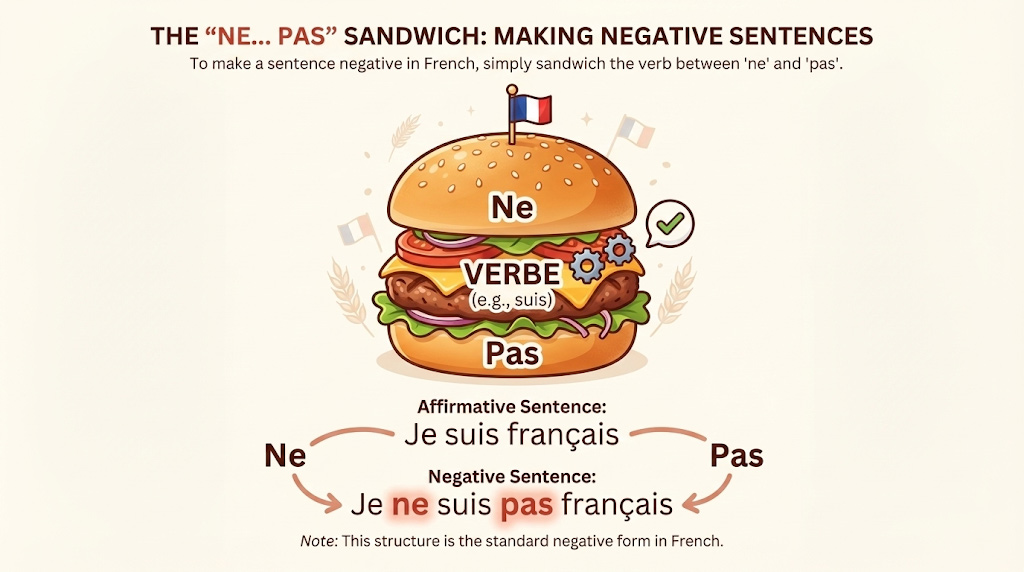
- Grammar: Basic negation. Je ne suis pas français (I am not French). The ne… pas sandwich around the verb is the standard negative structure.
Week 4: Action and Movement
It is time to start moving.
- Focus: High-frequency verbs and basic questions.
- Key Verbs: Aller (to go) and Faire (to do/make). Along with être and avoir, these form the “Big Four” verbs.
- Question Words: Qui (who), Quoi (what), Où (where), Quand (when), Pourquoi (why).
- Outcome: By the end of Week 4, you should be able to say: “I am going to the restaurant.” (Je vais au restaurant.) or ask “Where is the station?” (Où est la gare?).
French words for beginners: start with words you’ll actually use
One of the biggest mistakes beginners make is trying to learn “zoo animals” or “kitchen appliances” before they know how to say “I want.” To be efficient, you must prioritize high-frequency french words for beginners. These are the words that appear constantly in daily conversation.
We have organized these into practical “survival” clusters.
1. The “Magic Words” (Social Lubricant)
In France, walking into a shop without greeting the owner is considered rude. These words are your social passport.
| French Word | Pronunciation Approx. | Meaning | Context |
| Bonjour | bohn-joor | Hello / Good day | Use until roughly 6 PM. Mandatory greeting. |
| Bonsoir | bohn-swahr | Good evening | Use after 6 PM. |
| Merci (beaucoup) | mehr-see (boh-koo) | Thank you (very much) | Universal gratitude. |
| S’il vous plaît | seel voo pleh | Please (formal) | Use with strangers/elders. |
| Pardon | par-dohn | Sorry / Excuse me | Bumping into someone or asking to pass. |
| Excusez-moi | ex-kew-zay mwah | Excuse me | Getting attention (e.g., a waiter). |
2. The Core Verbs (The Engine of Sentences)
You cannot form a sentence without a verb. Focus on these irregular but vital powerhouses.
- Être (To be): Je suis (I am), Tu es (You are), Il est (He is).
- Avoir (To have): J’ai (I have), Tu as (You have), Il a (He has).
- Aller (To go): Je vais (I go), Tu vas (You go).
- Faire (To do/make): Je fais (I do), Tu fais (You do).
- Vouloir (To want): Je voudrais… (I would like… – polite form)..
3. Survival Nouns (Travel & Needs)
- L’eau (Water) – loh
- Le café (Coffee) – luh kah-fay
- L’addition (The bill) – lah-dee-syon
- La gare (The train station) – lah gahr
- Les toilettes (The bathroom) – lay twah-let
- La carte / Le menu (The menu)
4. Small but Mighty Connecting Words
These little words glue your sentences together.
- Et (And)
- Ou (Or)
- Mais (But)
- Avec (With)
- Sans (Without)
- C’est (It is / That is) – Used constantly! E.g., C’est bon (It’s good), C’est facile (It’s easy).
Pro Tip: Do not just memorize the list. Use “Sticky Note Immersion.” Write these words on sticky notes and place them on the corresponding objects in your house (mirror, fridge, door, coffee machine). Every time you touch the object, say the word aloud.
Common mistakes beginners make when learning French (and how to avoid them)
Making mistakes is not just normal; it is necessary. It is how your brain calibrates its understanding of the new system. However, English speakers tend to fall into the same specific traps. Awareness of these can save you hours of frustration.
1. Pronouncing the Silent Letters
The Mistake: Looking at the word Paris and pronouncing the “s” at the end, or saying the “t” in chat (cat).
The Fix: Remember the “CaReFuL” rule. Generally, if a French word ends in C, R, F, or L, you pronounce the final letter. If it ends in most other consonants (especially S, T, D, P, X, Z), it is silent.7
- Sac (bag) -> Pronounce the C.
- Chat (cat) -> Silent T.
- Paris -> Silent S.
2. The “Tu” vs. “Vous” Social Minefield
The Mistake: Using Tu (informal you) with everyone, because English only has one “you.”
The Fix: French distinguishes between social closeness and distance.
- Use Tu with: Children, animals, close friends, family, and peers (after invited to do so).
- Use Vous with: Strangers, shopkeepers, elders, bosses, and groups of people (plural).
- When in doubt: Always start with Vous. It is polite. Starting with Tu can be seen as rude or aggressive.
3. The “False Friends” (Faux Amis)
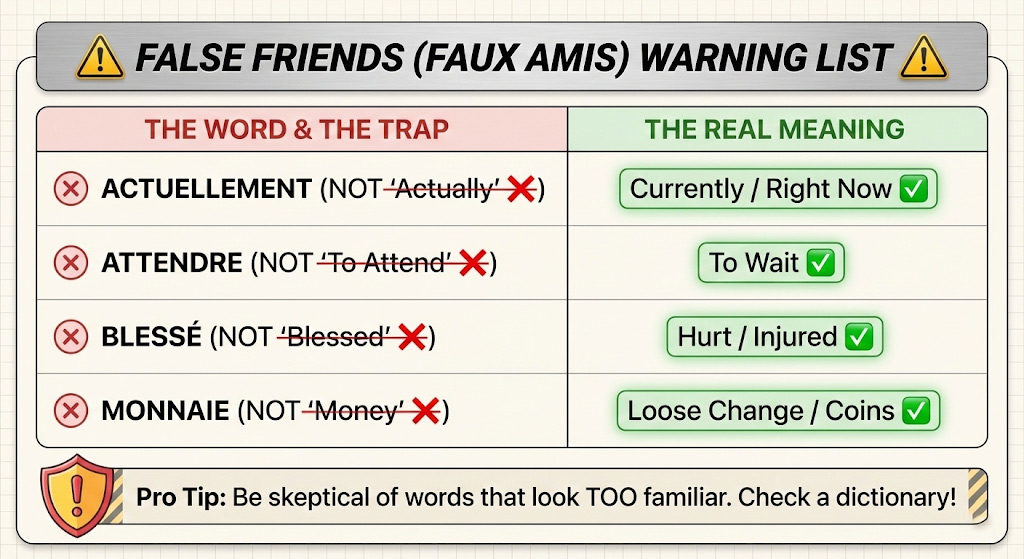
The Mistake: Assuming a word means what it looks like in English.
The Fix: Be skeptical of words that look too familiar.
- Actuellement does NOT mean “Actually.” It means Currently (right now).
- Attendre does NOT mean “To attend.” It means To wait.
- Monnaie does NOT mean “Money” (in general). It means Loose change (coins
- Preservatif does NOT mean “Preservative.” It means Condom. (This is a classic embarrassment for learners!)
4. Literal Translation of Idioms
The Mistake: Translating English phrases word-for-word.
The Fix: Learn the French concept, not the translation.
- I am hot: English speakers say Je suis chaud. In French slang, this implies you are sexually aroused. To talk about temperature, you must use avoir (to have): J’ai chaud (I have heat).
- I miss you: English speakers say Je te manque. This actually means “I am missing to you” (You miss me). The correct phrase is inverted: Tu me manques (You are missing to me).
How to make French beginner lessons fun and sustainable
Many people start learning French with a burst of intense energy—studying grammar for three hours on a Sunday—only to burn out by Wednesday. Sustainability is more important than intensity. You need to weave French into your life so that it feels less like “study” and more like “lifestyle.”
1. The “Micro-Dosing” Approach
Do not study for hours. Study for 15 minutes, twice a day. Research shows that “spaced repetition” (reviewing material at intervals) is far more effective for memory retention than cramming.
- Routine: 10 minutes of vocabulary apps over breakfast. 10 minutes of a podcast while driving. 5 minutes of review before bed.
2. Soundtrack Your Life (Music)
French music is a fantastic way to learn without trying. The rhythm helps words stick, and the emotional connection boosts memory.
- For Clear Vocab: Stromae (Pop/Hip-hop). His song Papaoutai is catchy and uses clear, modern French.
- For Classics: Edith Piaf (La Vie en Rose, Je ne regrette rien). She articulates very clearly and slowly.
- For Disney Fans: Listen to Disney songs in French (e.g., Ce rêve bleu for “A Whole New World”). You already know the tune and meaning, so you can focus on the French lyrics.
3. Netflix and Chill (Active Watching)
Watching French TV shows is great, but be realistic. You will not understand everything at first.
- The Strategy: Watch shows you have already seen in English, dubbed in French. Or watch French shows like Lupin or Call My Agent! (Dix pour cent).
- Subtitles: Start with French audio and English subtitles to get the plot. As you improve, switch to French subtitles to match the sound to the text. Eventually, turn them off.
- Reality TV: Shows like The Circle France or L’Agence (The Parisian Agency) are excellent because people use repetitive, everyday slang rather than scripted, poetic language.
4. Gamify Your Learning
If textbooks bore you, play games.
- Flashcards: Use apps like Anki or Quizlet. They use algorithms to show you words right before you are about to forget them.
- Post-it Wars: Challenge a partner or housemate to label as many items in the house as possible in 5 minutes.
- Simple Reading: Read comics (Bandes Dessinées) like Tintin or Astérix. The pictures provide context that helps you understand the text.
How long does it really take to feel comfortable in French?
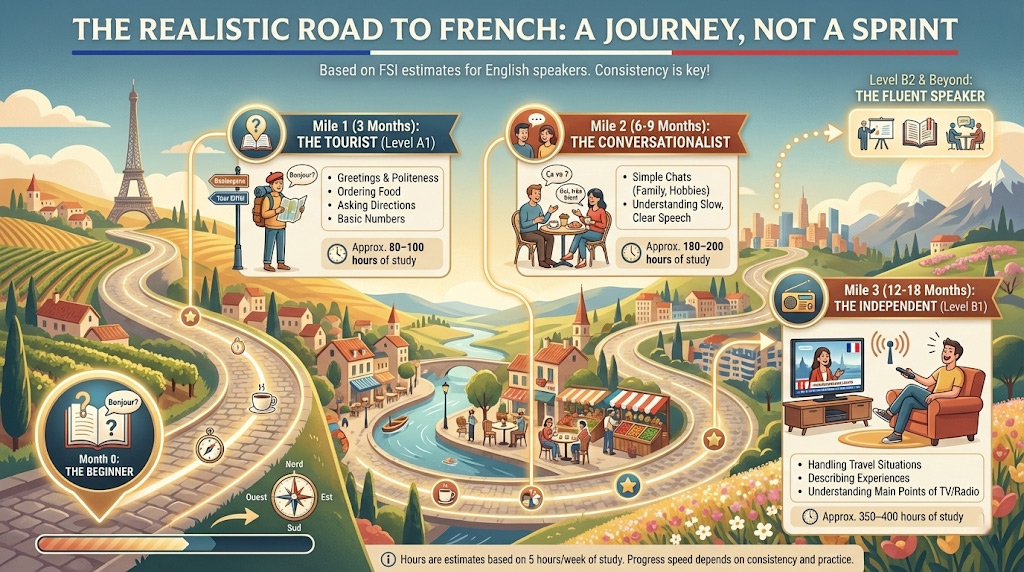
This is the million-dollar question. If you search online, you will find promises of “Fluency in 3 Months.” Be very skeptical of these claims. Language learning is a marathon, not a sprint.
The Foreign Service Institute (FSI) classifies French as a “Category I” language, meaning it takes approximately 600 to 750 class hours for an English speaker to reach “Professional Working Proficiency” (Level 3/B2-C1).
However, you probably do not need “Professional Proficiency” right now. You likely want “Social Proficiency” (Level B1)—the ability to handle travel, chats, and daily life.
A Realistic Timeline for the Hobbyist Learner:
- The “Travel Ready” Stage (A1):
- Goal: Greetings, ordering food, asking directions, basic numbers.
- Time: 80–100 hours. (Approx. 3–4 months of studying 5 hours/week).
- The “Conversational” Stage (A2):
- Goal: Simple exchanges about family, hobbies, and routines. Understanding slow, clear speech.
- Time: 180–200 hours. (Approx. 6–9 months at 5 hours/week).
- The “Independent” Stage (B1):
- Goal: Dealing with most situations while traveling, describing experiences, understanding the main points of TV/Radio.
- Time: 350–400 hours. (Approx. 12–18 months at 5 hours/week).
What affects this speed?
- Consistency: 20 minutes daily is better than 4 hours on Saturday.
- Background: If you already speak Spanish or Italian, you will likely learn French faster due to the similarities in grammar.
- Immersion: If you live in a French-speaking country, cut these times in half.
The Reality Check: You will hit plateaus. You will have days where you feel like you have forgotten everything. This is normal. Progress in language learning is not a straight line; it is a series of steps. As long as you keep engaging with the language, you are moving forward.
FAQ: Honest answers about French language for beginners
Is French an easy language to learn if I only speak English?
Relatively, yes. Compared to languages like Russian, Mandarin, or German, French is easier for English speakers because of the huge amount of shared vocabulary (cognates). However, the pronunciation and spelling can be tricky at first compared to Spanish.9
How hard is French language to learn compared to Spanish or German?
Spanish is generally considered easier in the beginning because it is phonetic (you say every letter you see). French is harder initially because of silent letters and pronunciation rules. German is often considered harder than French due to its complex case system and three genders, although its pronunciation is sometimes easier for English speakers to grasp.
What are the most useful French words for beginners?
Focus on the “Big Four” verbs: être (to be), avoir (to have), aller (to go), and faire (to do). Also, polite “safety” phrases like Je ne comprends pas (I don’t understand) and Pouvez-vous répéter? (Can you repeat?) are incredibly valuable.17
Can I learn French as an adult beginner?
Absolutely. While children may pick up accents faster, adults have better discipline, logic, and study strategies. Many people achieve fluency starting in their 30s, 40s, 50s, or beyond. The key is patience and not expecting to sound like a native immediately.39
How often should I study as a total beginner?
Aim for daily contact, even if it is short. 15 to 30 minutes a day is effective and sustainable. Consistency prevents your brain from “resetting” every time you study.15
What should beginner French lessons focus on first?
Focus on listening and pronunciation. If you learn to read words with the wrong pronunciation in your head, it is very hard to fix later. Listen to the language as much as possible to get the rhythm.
Final Thought: Learning French is a journey of discovery—not just of a new way to speak, but of a new way to see the world. It starts with a single Bonjour. Why not say it today?
Visual suggestions for this French beginner blog
To make this guide even more helpful, here are descriptions of visual aids that would clarify the concepts discussed:
- Infographic: The Iceberg of English Vocabulary
- Show: An iceberg. Above the water is “Germanic/Basic English” (cow, house, hand). Below the water is “French/Formal English” (beef, residence, manual).
- Purpose: To visually demonstrate that learners already know thousands of French words (cognates).
- Chart: The “CaReFuL” Pronunciation Rule
- Show: The letters C, R, F, L. Examples of words ending in these letters where the sound IS pronounced (e.g., Sac, Mer, Chef, Mal). Contrast with a “Silent Zone” bucket containing letters like S, T, D, P with examples (Paris, Chat, Tard).
- Purpose: To give a quick visual cheat sheet for reading aloud.
- Timeline: The Realistic Road to French
- Show: A winding path with milestones. Mile 1 (3 months): “The Tourist” (Ordering food). Mile 2 (9 months): “The Conversationalist” (Basic chats). Mile 3 (18 months): “The Independent” (Watching TV).
- Purpose: To set healthy expectations and combat “fluent in 30 days” myths.
- Diagram: The “Ne… Pas” Sandwich
- Show: A burger or sandwich. The top bun is “Ne”. The meat/filling is the “Verb”. The bottom bun is “Pas”.
- Purpose: To illustrate simply how to make negative sentences in French.
- Table: False Friends Warning List
- Show: Two columns with danger icons. Words like Actuellement, Attendre, Blessé, Monnaie with their False meaning (crossed out) and their Real meaning (highlighted).
- Purpose: To prevent common embarrassing mistakes.